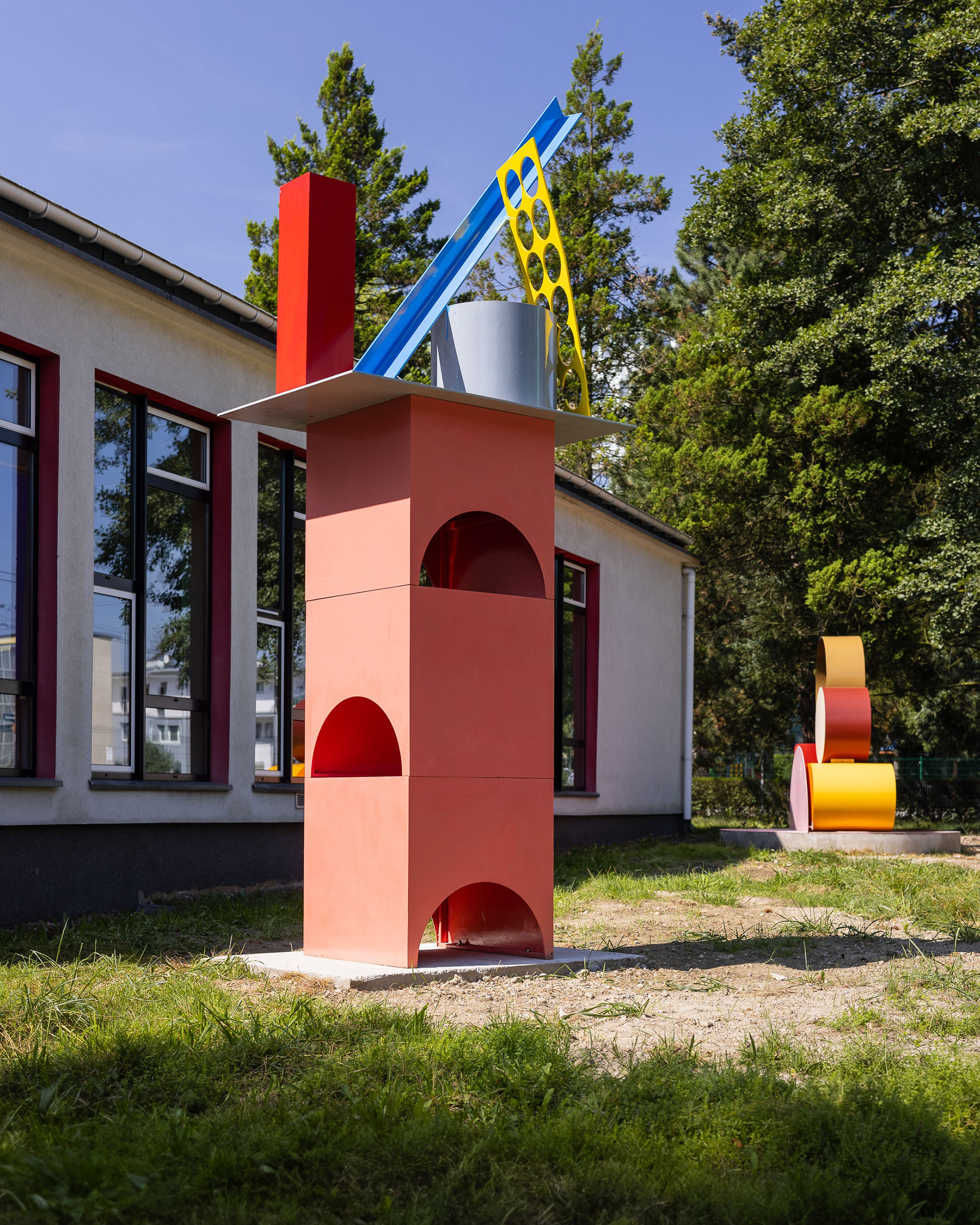
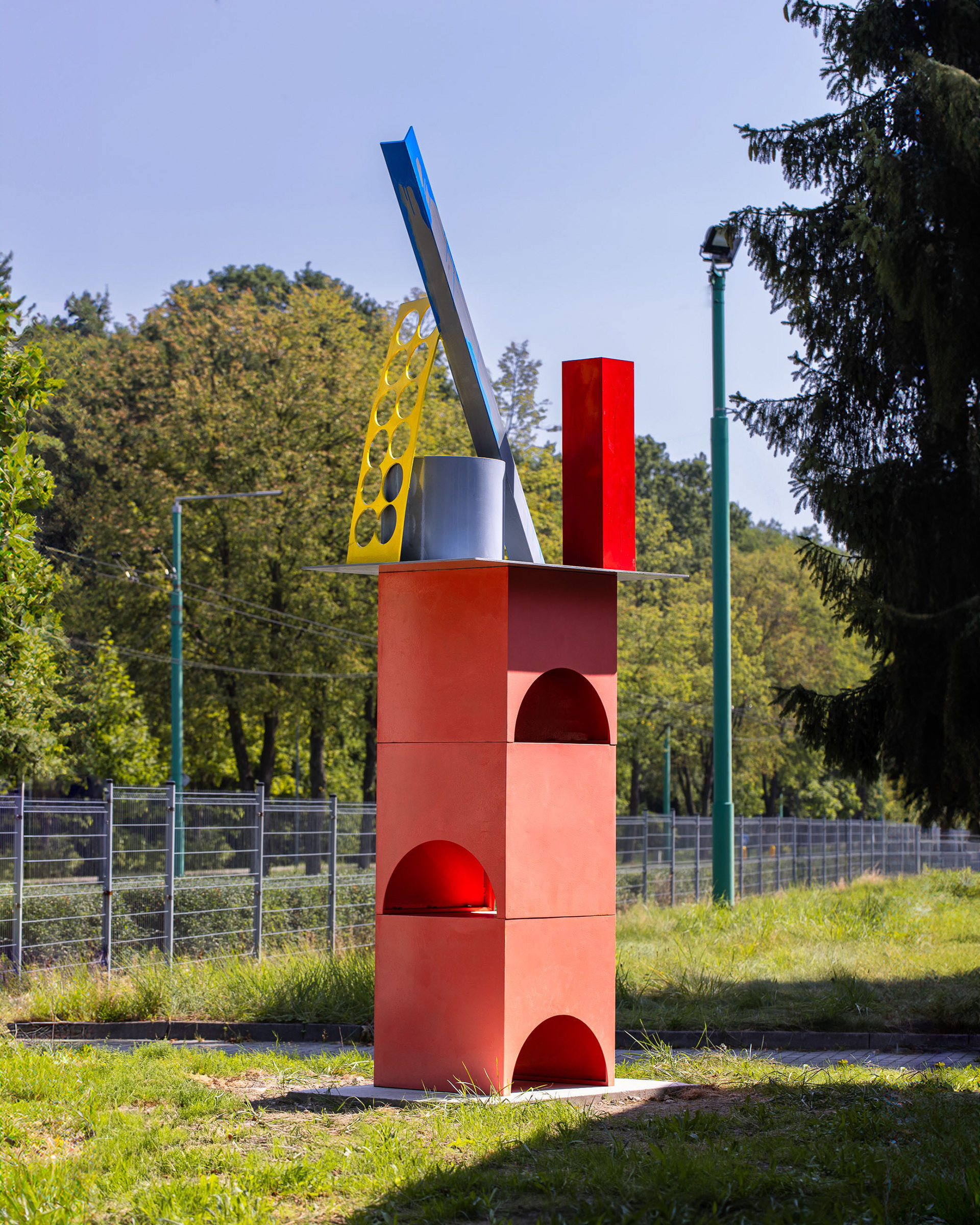
Permanent public sculpture - lacquered steel on concrete foundation.
400 cm tall x 200 cm wide x 150 cm deep. Commissioned by Razem Pamoja Foundation for Stanisław Wyspiański III High School in Tychy, Poland.
400 cm tall x 200 cm wide x 150 cm deep. Commissioned by Razem Pamoja Foundation for Stanisław Wyspiański III High School in Tychy, Poland.
Composed of brightly painted geometric forms, Outdoor Geometry Lesson draws inspiration from modernist sculptures, metalwork, playground structures, and other forms of public art embedded throughout Tychy’s communist-era urban landscape. Rather than treating these forms nostalgically, the sculpture reworks their visual language through shifts in scale, proportion, and abstraction, turning familiar geometries into something simultaneously architectural, playful, and unfamiliar. The commission forms part of Powrót do Szkoły (Back to School), a project seeking to renew the historical integration of art into Polish schools and other public spaces.
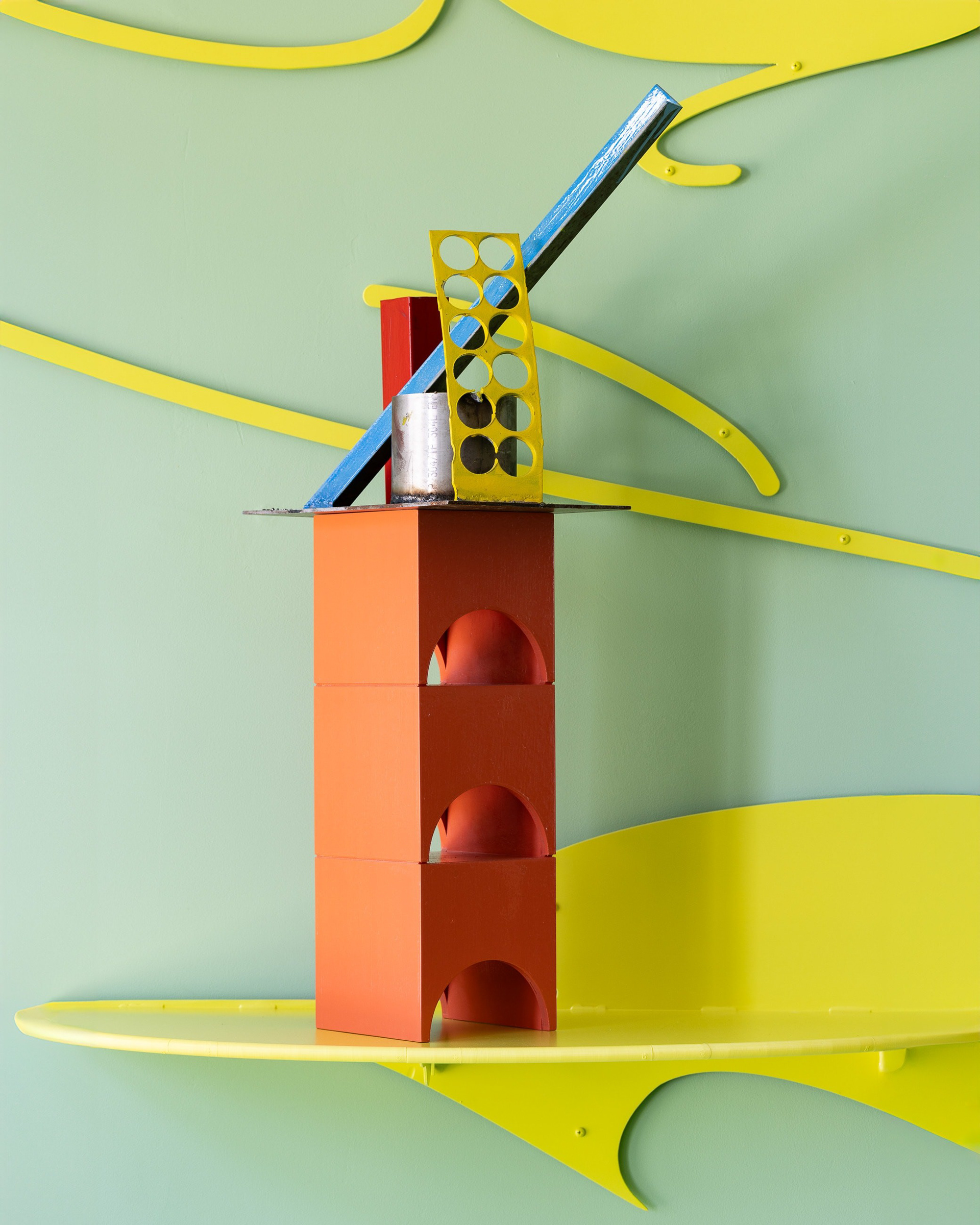
The work developed from a much smaller sculptural model begun in 2020, in which questions of play, experimentation, and scale were already central. Enlarged into a public sculpture, the model becomes an inhabitable element of the school landscape, collapsing the distance between an imagined object and its realization. Outdoor Geometry Lesson considers how abstraction can operate as a form of memory, connecting past and present while asking how the visual language of one political and architectural era might be reconstructed and given new meaning within contemporary public space.
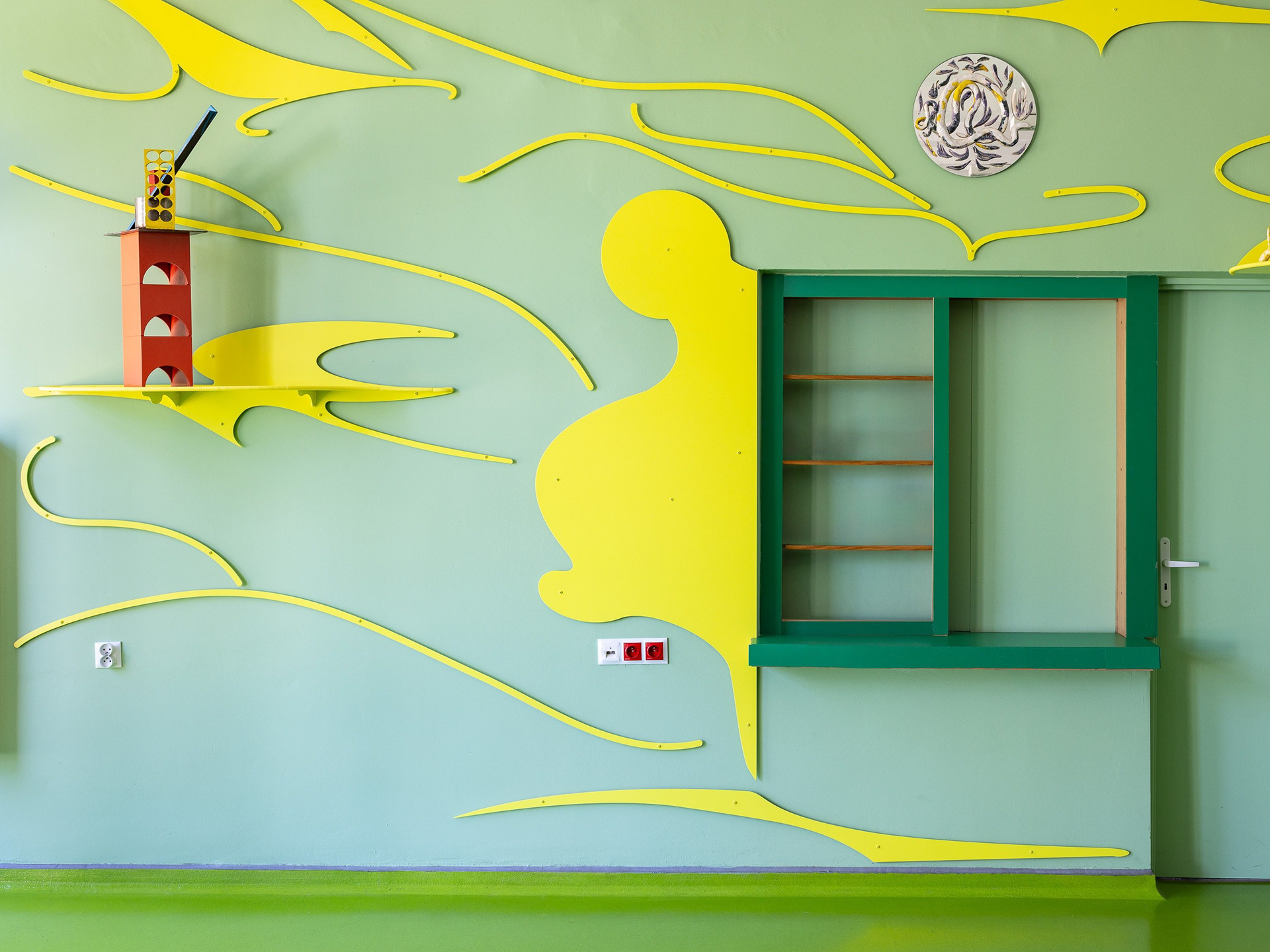
The curator, Magdalena Lazar, states:
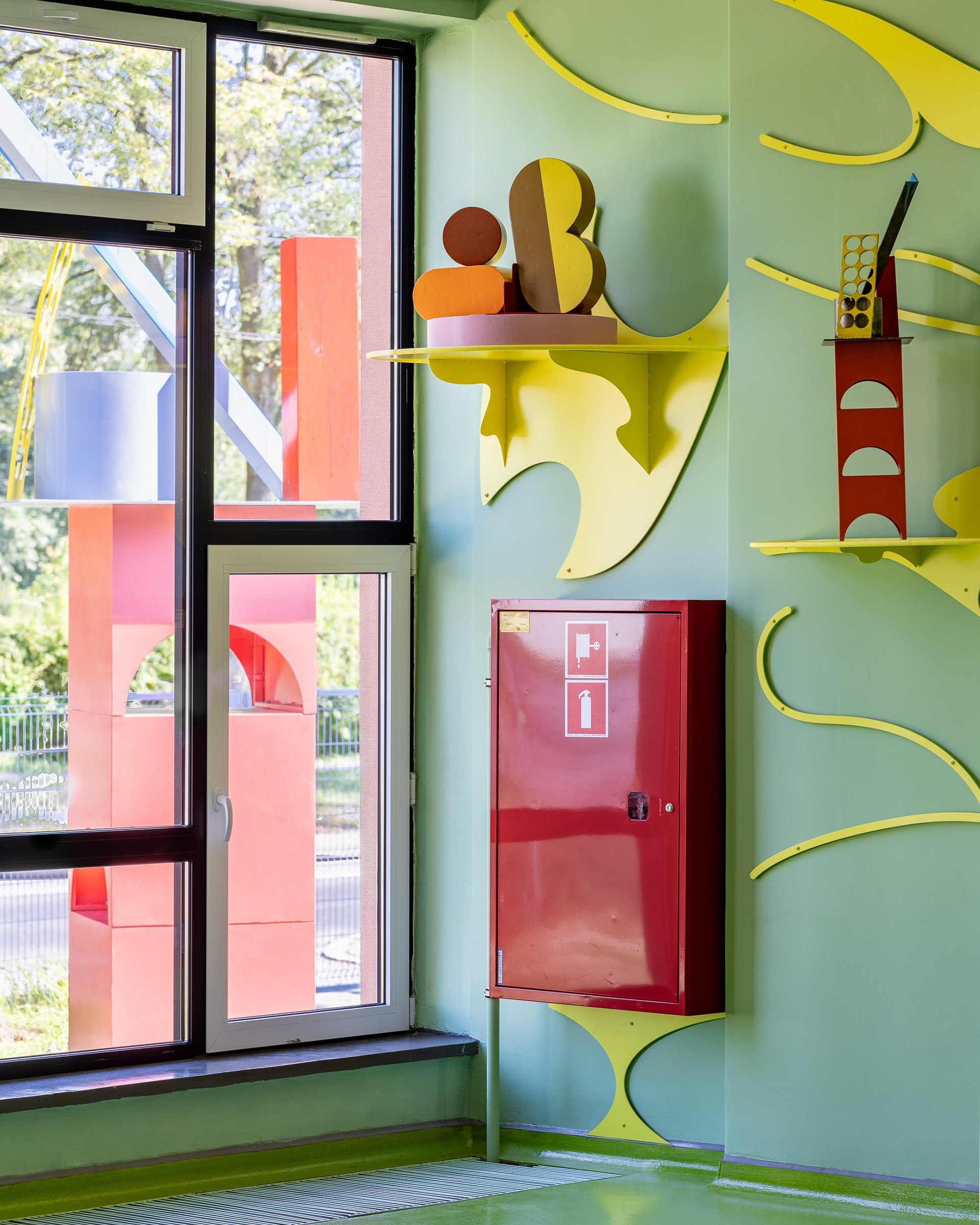
"We created a unique space for the III High School in Tychy by introducing the works of contemporary artists to the school. Yellow metalworks serve as frames for the quasi-exhibition organized in the school canteen. Its form references modernist ideas and the 1960s fascination with conquering outer space. The artwork has an open composition, meaning it is not rigidly enclosed in a single form but instead creates the impression of continuous movement and change. The work's organic character, evoking nature, suggests a biocentric approach to perceiving reality. In other words, it suggests that reality does not exist in one objective form – how we perceive it depends on our senses, and our senses differ from the senses of other creatures. Each organism experiences the world differently.
The metal elements, as well as the space of the canteen itself, feature small works by contemporary artists: Paulina Włostowska, Aleksandra Liput, Natalia Kopytko, Przemek Pyszczek, Katarzyna Olma, Jan Wolski, and Marta Niedbał. Looking out from the window, we can see two of these works on a large scale. At the same time, the exposition tells us about the relationship between the model and reality. It shows us the path from dreaming to fulfilling our dreams."